Friday, January 9, 2015

Patriots-Ravens Preview

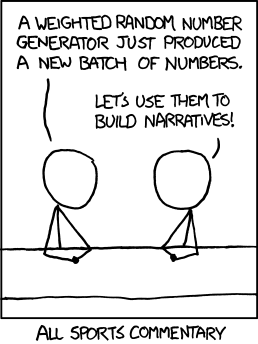
The Patriots and Ravens will play on Saturday for the fourth time in the playoffs since 2010. The Ravens hold a 2-1 edge in those matchups. In 2010, the Ravens upset the Patriots 33-14 and in 2013 beat New England 28-13 in the AFC Championship game. In 2012, the Patriots beat Baltimore 23-20 also in the AFC championship game. But the most important question is do these previous matchups have any predictive value for this week’s game?  
            No. The players, some of the coaches, and some of the schemes are all different. Lazy sports writing would have you believe that the Ravens have the key to beating New England or whatever other false narrative you’d like to construct. But the truth of it can be summed up this way

 Sports
Moving on.

SETTING THE CONTEXT


Total DVOA
Weighted DVOA
Offensive DVOA
Defensive DVOA
Special Teams DVOA
New England
22.4% (4)
31.4% (2)
13.6% (6)
-3.4% (11)
5.5% (5)
Baltimore
22.2% (5)
23.0% (5)
9.7% (9)
-4.6% (8)
8.0% (2)

            At first glance, this seems to be a game featuring two evenly matched teams. They ranked 4th and 5th in Football Outsiders DVOA rankings. When factoring in late season performance, as weighted DVOA does, the Patriots have a more significant advantage. The Patriots feature a better offense, while the Ravens hold slight advantages in defense and special teams. Yet in order to predict how this game may actually turn out we need to go even deeper into the matchups.

THE PATRIOTS ON OFFENSE


Weighted DVOA
Passing DVOA
Rushing DVOA
New England Offense
19.4% (4)
35.0% (5)
-3.6% (14)
Baltimore Defense
-6.1% (13)
5.9% (15)
-19.3% (5)

            Since settling on an offense line with rookie Bryan Stork at center and Ryan Wendell and Dan Connolly at the guard positions, following a week four loss to Kansas City, the Patriots offense has taken off. When the Patriots can protect Tom Brady, they can exploit favorable matchups. Whether that is featuring six offensive linemen and running all over the Colts in week 11 or having Tom Brady and company shred the Lions pass defense in week 12. The offensive line will again play the starring role in Saturday’s game. If Baltimore can bring pressure with its four defensive linemen, highlighted by Terrell Suggs, Haloti Ngata, and Elvis Dumervil, then Brady could be in for a long day. Generating consistent pressure with four linemen would allow Ravens defensive coordinator Dean Pees to leave seven men back in coverage. These extra defenders could blanket offensive weapons like Rob Gronkowski, Julian Edelman, and Brandon LaFell and cut off Brady’s throwing lanes. This has long been the way to beat Brady or any other of the league’s elite quarterbacks.
            Being able to drop seven men into coverage would also allow Ravens to mask the weakest part of their defense: the secondary. In last week’s game against Pittsburgh, the strong pass rush took pressure off the Ravens depleted defensive backfield. So far this season, the Ravens have lost four different cornerbacks to season ending injuries. Things became so bad that Grantland NFL football writers Bill Barnwell and Robert Mays played a game on their podcast called “Ravens defensive back or actor from The Wire.” If the line can protect Brady, then he should be able to pick apart the Ravens secondary. The key matchup to watch is tight end Rob Gronkowski on safety Will Hill. If Gronk takes off up the seam one on one against Hill, the Ravens are in trouble. The Patriots could create additional pressure by going up-tempo and limiting Baltimore’s ability to substitute its defenders.

THE RAVENS ON OFFENSE


Weighted DVOA
Passing DVOA
Rushing DVOA
Baltimore Offense
6.4% (8)
32.6% (6)
-6.0% (18)
New England Defense
-6.2% (12)
2.0% (12)
-10.4% (14)

            This year the Ravens implemented the zone running game of new coordinator Gary Kubiak. The zone running game and especially the outside zone play is all about lateral movement by the offensive linemen. Instead of stepping forward to block, linemen shift laterally or even take a step backwards in order to gain leverage to push defenders inside. If they can’t push defenders inside, then linemen need to push them towards the sidelines—opening up holes for the running back. This type of offense requires disciplined linemen who will stick to their blocking assignments. It also requires a running back capable of finding the holes opened by his offensive line rather than simply running forward. The zone running game, which Kubiak learned from his time in Denver with Mike Shanahan and Alex Gibbs, seeks to take advantage of undisciplined defenders who will leave their positions and open up holes for the running back.
 Unfortunately for the Ravens, any Bill Belichick coached defense features defenders who stick to their assignments. And the best path to a Ravens victory might be running the ball and keeping their defense on the sidelines. The Patriots, meanwhile, have had success against Kubiak offenses over the years including a 41-28 playoff victory in 2013 a few weeks after a 42-14 blowout victory in December 2012. Additionally in his last 5 games Ravens running back Justin Forsett has produced 71, 48, 19, 119, and 40 yards rushing—hardly the dominating performance needed to beat New England. Baltimore quarterback Joe Flacco excels at throwing the ball down the field and drawing pass interference penalties on opposing defenders. This Patriots secondary, however, is the best he’s ever faced. Say goodbye to Sterling Moore and Julian Edelman and say hello to Darrel Revis and Brandon Browner. While the Ravens may have a few big plays down field, it may not be enough to overpower this improved Patriots secondary.

SPECIAL TEAMS
(Measured by Expected Points Added)


Weighted DVOA
FG/XP
KICK
KICK RET
PUNT
PUNT RET
New England
5.8% (7)
10.8 (1)
8.4 (3)
0.5 (13)
-0.6 (18)
8.4 (5)
Baltimore
10.4% (1)
5.3 (7)
8.3 (4)
10.2 (3)
17.9 (1)
-1.9  (14)

            Both teams have excellent kickers and kicking games. The biggest matchup on special teams will be between the Patriots punting team and the Ravens return game led by Jacoby Jones. The Patriots need to keep Jones bottled up and control field position. One good return by Jones can result in great field position or even a special teams touchdown.  Also watch the Patriots on Ravens field goal attempts. They blocked kicks late in the season against the Dolphins and Jets.

THE PICK

            Watch the lines. If the Patriots can give Brady time in the pocket he should be able to take advantage. If the Ravens can establish the run game early and keep Brady on the sidelines, they have a good chance to win. My guess is the Patriots line holds up and gives Brady the time he needs to pick the Ravens apart. Patriots 27, Ravens 20.  

Thursday, November 13, 2014

Interstellar

            Christopher Nolan’s Interstellar is the movie equivalent of a chef armed with truffles, foie gras, and Wagyu beef grinding it up into meatloaf. The film’s cast is impeccable, the practical effects stunning, and its underlying ideas about space and exploration universal. Yet the outcome is more pedestrian than revelatory. The film unravels because of an overcomplicated plot and underwhelming theme.
            Nolan, as he often does, has assembled a stellar cast. Matthew McConaughey continues his string of strong performances by playing against his hyper-masculine type. In Interstellar, he stars as Cooper, an astronaut-turned-farmer-turned-astronaut. Mackenzie Foy plays Murph, Cooper daughter, and their chemistry drives the emotional beats of the film. Nolan populates the film with actors far too qualified for their roles. Michael Caine’s NASA scientist instigates Cooper’s journey to the stars. Anne Hathaway’s Amelia, another scientist leads the NASA crew on the spaceship Endurance. Bill Irwin voices TARS, a multi-limbed robot, who helps and humors the crew during their journey to a black hole in orbit near Saturn. TARS’s relationship with Cooper is the most grounded and realistic in the entire movie. The rest of the cast includes Jessica Chastain, John Lithgow, Casey Affleck, William Devane, Ellen Burstyn, Wes Bentley, David Gyasi, Topher Grace (looking like he’s just happy to be there) and a surprise unbilled A-list actor.
            The visual effects of Interstellar are remarkable. Nolan mostly eschewed CGI in favor for practical models for his depiction of space travel. His attention to detail pays off in a number of visually striking scenes. Saturn’s rings glitter and as the Endurance approaches its date with an artificially created wormhole. The camera remains fixed as the Endurance glides through space, spinning on its axis. Never has space looked so majestic.  Nolan’s view of space is the opposite of Alfonso Cuarón in Gravity. Where Cuarón stressed the claustrophobic and deadly nature of outer space, Nolan revels in its splendor and beauty. In Gravity, death and emptiness lurked around every corner. Protective spacecraft could easily become a deadly projectile. In Interstellar space is the next stage for mankind’s achievement—challenging, but awe inspiring.
            Interstellar’s themes and plot unravel everything good about the film. It is clear that Nolan is an advocate for mankind’s continued exploration of space. Our future lies out there, the film constantly reminds us. To call his method of delivering this message heavy handed would be an understatement. In a terribly written scene, Cooper laments to his father-in-law (Lithgow) about mankind’s failure to continue its space endeavors. He laments, “We used to look up at the sky and wonder at our place in the stars, now we just look down and worry about our place in the dirt.” On a future version of Earth where ecological disaster has ruined the planet’s food supply, maybe that sentiment is understandable? Later when the film shifts to space the heavy handedness continues. With the Endurance only capable of visiting one of two planets capable of sustaining life, Hathaway’s Amelia opts for the one where her lover is. In defending her position, Amelia argues that “Love is the one thing that transcends time and space.” The power of love and importance of discovery are hardly unique or new themes.
            Further the overstuffed plot dooms these themes further. At two hours and forty nine minutes, the film radically shifts in plot making it seem like three or four movies crammed into one. Interstellar begins as a movie about an ecologically ravaged Earth, struggling for survival. With a radically reduced population mankind has become a people of Dust Bowl era farmers. With Cooper’s discovery of NASA, the film becomes about mankind’s potential salvation through a wormhole. A mission of survival soon yields to easily excised conspiracy thriller. Meanwhile back on Earth, Murph (Chastain), now fully grown, struggles to save humanity from her end. This divided focus drains the plot of momentum as it toggles back and forth between the ever changing Endurance mission and Murph’s efforts to solve the problem of extricating Earth’s population to safety. In the last act, Cooper joins the two plots together by journeying into the black and proving that love does in fact transcend time and space. Love transcends time and space? Fantastic. Glad a film studio spent 165 million dollars on that one.
            Due to his success with the Dark Knight trilogy and other films like Memento, Inception, and The Prestige, Nolan had a rare opportunity in Hollywood to make whatever movie he wanted. He put this freedom to work with dazzling visual effects and reminded us of the wonder and majesty of space.  He surrounded himself with a marvelous and overqualified cast. Instead of putting them to their best use, Nolan squandered them on a heavy handed, simplistic, and ultimately empty film. 

Saturday, November 1, 2014

Fantasy Football: Over and Underachievers

            A few weeks ago I looked at scoring leaders through week 3, this week I’m going to look at one player at each position who have either dramatically over or underperformed relative to his draft value.
Quarterbacks
Phillip Rivers
            In 2013, Rivers threw for 4,478 yards with 32 touchdowns and only 11 picks. He scored 276 fantasy points, finishing 6th among quarterbacks and 7th overall. That performance did not win Rivers much respect from fantasy owners. He was an 11th round pick and the 14th quarterback off the board sandwiched between Johnny Manziel and Eli Manning. This year, under coach Mike McCoy, Rivers has continued his stellar play. He currently sports a 68.3% completion percentage, with 2,213 yards and 20 touchdown passes against only 5 interceptions. His 160 fantasy points place him fourth among quarterbacks. If you loaded up on wide receivers and running backs early and grabbed Rivers late, it’s paying off big time.

Cam Newton
            There are several viable candidates for this spot. I considered Drew Brees, Matthew Stafford, and finally settled on Newton. Last year, Newton finished third among quarterbacks with 282 fantasy points. He passed for 3,379 yards and 24 touchdown passes. Newton’s rushing set him apart as he ran for 585 yards and six rushing touchdowns. He averaged 17.625 points per game. This year, as the Panthers have crumbled, so have Newton’s fantasy numbers. Newton was a fifth round pick and is currently stuck between fellow mid-round QB disappointments Nick Foles and Andy Dalton as the 18th highest scoring QB. He has 214 yards on the ground with only one rushing TD. His average points per game has declined to a barely playable13.25.

Running Backs
Ahmad Bradshaw
            While the Colts continue to hand Trent Richardson the ball, Bradshaw has proven to be the better NFL and fantasy running back. He has scored 101 fantasy points behind 635 all purpose yards and 8 touchdowns. He’s rushed 76 times for an average of 4.88 yards per carry. He’s also caught 31 passes for an average of 15.53 yards per catch. Currently fifth among running backs in fantasy points, Bradshaw was on average a 14th round pick and the 50th running back taken overall. Under Andrew Luck, the Colts have been one of the most prolific offenses in the league, creating scoring opportunities for players like Bradshaw. His touchdown pace is unlikely to continue, but enjoy the ride while it lasts.

LeSean McCoy
            Let’s play a game of blind resumes.


Carries
Yards
TDs
Fantasy Points
McCoy
137
505
1
58
Player B
101
358
2
58
Player C
74
251
3
58
Players B and C are the aforementioned disappointment Trent Richardson and Vikings backup Matt Asiata. McCoy was a top five pick, while Asiata went undrafted. The lack of touchdowns has killed McCoy’s value this season. In ESPN standard scoring McCoy has 4 games of single digit fantasy points. He has rushed for over one hundred yards once, against the Giants in week six. He’s still getting about twenty rushes per game, but his inability to find the endzone has caused a lot of consternation for his owners. McCoy is a reminder that you can’t win your league with the right first round pick, but you can lose it with the wrong one.

Wide Receivers
T.Y. Hilton
            Hilton has emerged this season as Andrew Luck’s favorite wide receiver target. He has scored 96 fantasy points, good for 5th among wide receivers. He leads the NFL in receiving yards with 886. The sheer volume of his receptions, tied for 3rd, make up for his only two touchdowns. Not bad for an eighth round pick and the 26th wide receiver off the board. Hilton has been especially dangerous the last five weeks. He started out slow, with 4, 6, and 8 fantasy points in Weeks 1-3. Since Week 4, however, Hilton has 10, 9, 28, 10, and 21 points. If Hilton can pick up the touchdown pace he might finish in the top 3.

Brandon Marshall
            It worked so well last time, let’s do another batch of blind resumes.


Receptions
Yards
Touchdowns
Fantasy Points
Player A
24
470
3
62
Marshall
34
385
5
62

Player A is San Diego wideout Malcom Floyd. On average, Floyd went undrafted in an ESPN standard 10 team league. Marshall was the fifth wide receiver off the board in the 3rd round. He’s currently tied with Floyd for 22nd in wide receiver scoring. Marshall has surpassed one hundred yards once this year, in week six against Atlanta’s anemic defense. He hasn’t scored a touchdown since Week 4 against Green Bay. His only standout performance was in week 2 against San Francisco when he caught three touchdown passes. If you remove that game Marshall is averaging 5.71 fantasy points per game. Forget starting him, that’s not even worth owning in a standard fantasy league.

Bonus: Seattle Defense
            Every year in fantasy leagues, people draft defenses way too high. They don’t recognize (or they don’t care) that the difference between the 1st and 10th ranked defenses is extraordinarily small.  Nor are teams consistent from year to year. This year was no different. After last year’s historic performance, ESPN drafters fell in love with the Seattle defense. They were drafted on average at the top of the 5th round, right between Matthew Stafford and running back Frank Gore. This year, the Seahawks D has scored 38 fantasy points, tied for 17th. The top three defenses, the Dolphins, Lions, and Bills were 16th, 17th, and 15th defenses drafted on average. Rather than waste a middle round pick on a defense, take somebody like Ahmad Bradshaw or T.Y. Hilton.

Saturday, October 25, 2014

The 2014 Saints

            In 2013, following the return of head coach Sean Payton and the arrival of new defensive coordinator, Rob Ryan, the New Orleans Saints posted a record of 11-5. In the playoffs, they beat the Philadelphia Eagles 26-24 before falling 23-15 to the Seattle Seahawks in the divisional round. The Saints had Super Bowl aspirations entering 2014. Despite being tight against the salary cap, they resigned tight end Jimmy Graham to a four year deal and brought in safety Jarius Byrd from the Bills to bolster their defensive backfield. The moves indicated that the Saints wanted to win another Super Bowl before the end of quarterback Drew Brees’s career.
            Currently the Saints’s record is 2-4, second in the NFC South. Three of their losses have been by a combined six points. In games decided by six points or fewer the Saints are 1-3. Some of this poor record is simply bad luck—a play or two goes the other way in any of the Atlanta, Cleveland or Detroit games and suddenly the Saints are 5-1. But luck isn’t the sole reason for the Saints poor record through seven weeks. In order to understand where the Saints have faltered this year, we need to dig a little deeper. So let’s start with their average production on drives (courtesy of Football Outsiders).

Saints Drive Statistics


Yards/Drive
Points/Drive
Plays/Drive
LOS/Drive
Offense
41.86 (1)
2.48 (7)
6.81 (1)
22.73 (31)
Defense
37.20 (29)
2.53 (30)
6.47 (29)
25.45 (9)

The Saints offense has managed the most yards and plays per drive in the NFL. Yet they are only seventh in points. Brees’s seven interceptions (more on turnovers later) have contributed to this lower than expected scoring output. They have also suffered from lousy field position, 31st in the league. It’s great to have lots of plays and yards, but it’s hard to convert them into points if you have to traverse the field much farther than your opponents. And most importantly, for every long drive the offense manages to string together, the defense gives it right back. Saints opponents are nearly matching the offense in terms of production. Think of it this way, this year the Saints offense has played against itself on the other sideline. It’s hard to win a lot of games that way.

SAINTS ON OFFENSE

            While it would be easy to place the blame for the Saints poor start solely on the defense, there’s more to the story than that. So let’s go deeper on the Saints offense.

Saints Overall Offense 2013 vs. 2014


Points/Game
Yards/Game
Adj. Sack Rate
Offensive DVOA
Pass DVOA
Run DVOA
2013
25.9 (10)
399.4 (4)
5.3% (4)
16.0% (5)
35.9% (3)
-5.3% (19)
2014
25.8 (10)
437 (2)
2.9% (2)
11.8% (7)
18.3% (15)
10.2% (2)

            At first glance, the Saints offense seems to be humming along as usual. They’re scoring at almost an identical rate as last season. They’re even averaging more yards per game. The offensive line has kept Brees off his back, allowing sacks on only 2.9% of his dropbacks. Even their overall offense according to DVOA (explained here) is similar to last season. Yet when we look closer at their passing and running games, a disturbing trend begins to emerge. The passing game that has terrorized opponents since Sean Payton and Drew Brees arrived in New Orleans has declined significantly from last season.

Saints Passing Offense


Yards/Game
Plays of 20+ Yards
Average 20+ Yard Plays/Game
Yards per Reception
2013
307.4 (2)
67
4.1875
11.6 (14)
2014
314 (2)
18
3
10.8 (25)
           
            The Saints offense is producing similar yards per game, but the decline stems from the lack of big plays down the field. Over the Payton-Brees partnership the Saints have always relied on a balance of short passes to their running backs and wide receivers and deep throws down the field. The short passes function as an extension of their running game. They get the ball to their pass catchers in space and pick up chunks of yardage. Downfield passes prevent teams from stacking the line of scrimmage and smothering the short passing game. This season the Saints have largely lacked that deep threat. Their average number of plays 20+ yards downfield has fallen dramatically and consequently so has their average yards per reception. Without the threat of quick score on a long pass, the Saints cannot generate the big scoring plays that build leads and create extra possessions.

SAINTS ON DEFENSE

Saints Defense 2013 vs. 2014


DVOA
Pass DVOA
Run DVOA
Points per Game
Run Yards per Game
Adj. Sack Rate
3rd Down Conversions
2013
-5.8% (10)
-9.2% (6)
-1.5% (20)
19.0 (4)
111.6 (19)
8.6% (4)
34.7% (9)
2014
17.7% (32)
39.3% (30)
-8.6% (16)
27.5 (28)
103.2 (11)
3.6% (29)
46.3% (26)

The Saints’ defensive decline has been staggering. A quick look at DVOA reveals where the Saints defense has gone wrong this year. The Saints front four has generated little pressure on the quarterback as evidenced by their atrocious adjusted sack rate. Pass rushers Cameron Jordan and Junior Gallette have failed to build on their breakout from last year. The inability to pressure the quarterback has exacerbated the problems in the defensive backfield. The Saints pass defense is similarly woeful. Last year the defense allowed 194.1 passing yards per game, second in the league. This year, they rank 28th with 270.5 yards per game. The defensive backs have been especially burned by opponents’ number one receivers, allowing 108.2 yards per game compared to only 48.6 last year. Part of this problem has stemmed from poor play by the defensive backs. Opposing offenses have repeatedly picked on defensive backs Patrick Robinson and Corey White. Robinson and White both played extensively last season, but with the departure of Malcolm Jenkins, Jabari Greer, and Roman Harper have been called on to play a bigger role in the defense. So far they haven’t been up to the task. The season ending injury to Jarius Byrd has only worsened the problem. Byrd’s coverage skills were supposed to meld well with second year safety Kenny Vaccaro’s run defense. Bad defensive backs are especially deadly in Rob Ryan’s defensive system.

Rob Ryan Defenses by DVOA


DVOA (rank)
Pass DVOA (rank)
Run DVOA (rank)
2004 OAK
11.5% (26)
29.2% (30)
-4.6% (15)
2005 OAK
1.9% (20)
13.1% (27)
-8.5% (14)
2006 OAK
-8.0% (8)
-16.1% (4)
-1.6% (17)
2007 OAK
5.7% (20)
-1.3% (13)
11.9% (32)
2008 OAK
3.7% (19)
-0.1% (13)
6.7% (28)
2009 CLE
16.4% (30)
27.1% (28)
5.4% (30)
2010 CLE
1.7% (18)
4.6% (18)
-1.1% (22)
2011 DAL
0.4% (16)
8.5% (20)
-10.9% (8)
2012 DAL
6.7% (23)
16.2% (25)
-4.1% (19)
2013 NO
-5.8% (10)
-9.2% (6)
-1.5% (20)

            Over his career as a defensive coordinator, Ryan has predicated his defenses against stopping the run. By focusing on stopping the run, Ryan likes to put his opponents in third and long situations, forcing them to pass. In those situations, Ryan can rely on his defensive creativity to confuse opposing quarterbacks and force them to make mistakes. As part of his defensive game planning, Ryan, like his brother, features what is called an “amoeba defense” (it’s also known as a “psycho front”). Here’s a picture of it below.


            This picture is from the first game of the 2013 season. The amoeba relies on confusing the opposing quarterback by keeping the defenders moving around, disguising who will rush the quarterback and who will drop into coverage. Only one Saints defender (defensive end Cameron Jordan) has his hand on the ground—the traditional stance for rushing the passer. Everyone else is standing and able to either rush or drop back depending on the play call. While the amoeba defense can be quite effective in confusing opposing quarterbacks (the Ryan brothers have had success against Brees, Brady, and Manning using it), it is high risk and high reward. The amoeba is particularly susceptible to run plays and screen passes. In the above situation, the Saints dare the Falcons to run the ball. They have few defenders in position to stop the run at the line of scrimmage. Screen passes are also effective because they get the ball out of the quarterback’s hands quickly and away from the constantly moving defenders. The amoeba is also less successful when the other components of the defense: the pass rush, defensive backs are less successful. In order for the amoeba to be successful, the defense needs to force their opponents into disadvantageous situations.

TURNOVERS


INT
Fumbles
Total
Offense
7
4
11
Defense
3
1
4
Turnover Differential


-7

The Saints have lost the turnover battle this season. Some of that is due to bad luck. The Saints defense has forced four fumbles, but only recovered one of them. Meanwhile opponents have forced five fumbles and recovered all of them. Additionally Brees has thrown more interceptions than usual. His TD/INT ratio this year is 1.57, well below his career average of 2.03. Even worse is that Saints opponents have turned six of those seven INTs into touchdowns. Some of this turnover luck should even out. The Saints should recover a few more fumbles and their opponents will recover a few less.

Overall, the Saints season has been a combination of poor play and bad luck. The luck should even out, but the poor play will determine if the Saints can make a run in the weak NFC South. 

Sunday, October 12, 2014

Liam Neeson Movie Marathon

            Last weekend, my wife, Casey, and I decided to open a bottle of wine and watch some mindlessly entertaining movies. The bottle of wine, a Malbec called Layer Cake, had chocolate cake on the label—too bad the label was the best part of the wine. For mindless entertainment, we chose two Liam Neeson movies, Taken 2 and Nonstop. Taken 2 proved mostly a sluggish bore, while Nonstop was a ludicrous and entertaining thriller.    
            I am an unabashed fan of the first Taken. I first watched it at my parents’ house when my brother had ordered it from Netfix (remember when you used to get discs from Netflix?).  The first half hour was laborious, but necessary for establishing the plot. It portrayed Neeson’s Bryan Mills as a man with a special set of skills and tried to convince the audience that Maggie Grace (playing Neeson’s daughter Kim) could pass as a sixteen year old girl. Once Kim gets kidnapped the film kicks into high gear. It surges forward as Neeson’s Mills swiftly and ruthlessly does whatever is necessary to find his daughter. Along the way he destroys a trailer park brothel, shoots up a building full of Eastern European human traffickers, interrupts a high end party by shooting its host, and finally kills a boatful of men protecting the Arab sheik who bought his daughter. Note the not so subtle reveal of how the sexual exploitation of women transcends social class.  In the end, Mills saves his daughter and goes home happy. Taken is not an intellectually or morally complex movie, rather it’s an action movie that for the last hour remembers why we like action movies in the first place. Neeson propels the plot from each escalating set piece by unabashedly displaying his determination and desire to get his daughter back.
Taken 2 sputters around by focusing too much on Bryan Mills’s family life.  Maggie Grace is 32 and ten years ago played a teenage girl on Lost. Yet the film begins by insisting that Kim is now only old enough to be taking her driver’s test. There’s also Bryan still pining for his ex-wife, her crumbling marriage, and Kim’s new boyfriend. Eventually the film shifts to Istanbul where the patriarch of the Eastern European traffickers from the first film has sworn revenge. Unfortunately, the patriarch (I’m not sure he’s even given a name) spends much of the film driving around Istanbul, issuing orders, and mumbling about getting revenge for scumbag son. The action scenes drag as well. Rather than using the set pieces to build towards a climatic confrontation, the film divides its time between two finales. First Kim must help save Bryan from his kidnappers. She casually tosses grenades, deftly avoids her kidnappers, and demonstrated Formula One level driving skills as she navigates a stick-shift cab through Istanbul. The second half features Bryan hunt down the patriarch only to have him give up without a fight. What should have been an uncomplicated action sequel instead became burdened down by the useless baggage from the first film.

            Nonstop fulfilled all the hopes I had for Taken 2. Neeson plays a former NYPD officer turned air marshal who receives a death threat from a passenger. 150 million dollars in twenty minutes or a passenger dies. The plot then barrels forward as Neeson searches for the culprit. His paranoia builds along with the body count. Overqualified actors surround Neeson at every turn, lending an air of seriousness and sincerity to a ludicrous airplane thriller. The pilot is Batman’s dad! The stewardesses are Lady Mary from Downton Abbey and Patsey from 12 Years a Slave. Four time Oscar nominee Julianne Moore plays Neeson’s seatmate. Character actor Corey Stoll also portraying a cop, lends credence to the passengers who question and resist Neeson’s actions. As Neeson struggles with his own past—his daughter died and he was a terrible father—the plot propels ludicrously forward as friends become enemies, enemies become friends, and around and around it goes. The film’s ostensible point is about post 9/11 complacency about airline safety, but theme and logic don’t matter here. The filmmakers deliver a satisfying and physically impossible climax as Neeson shoots the bad guy while the plane crashes around him. The film’s fun comes from watching Neeson and the rest of the talented cast unravel the insanity around them.